About the Journal
The Journal of Research for International Educators is founded by the Consortium for Global Education (CGE) - Research Institute. https://www.cgedu.org/researchinstitute
The Consortium for Global Education (CGE) https://www.cgedu.org is a non-profit global organization with a membership of accredited American private universities and colleges with consortium member campuses, located in more than 23 USA states and 6 nations, are equally committed to quality programs of international education. Affiliate members represent key national universities worldwide. Each member of the consortium is committed to a high value of quality academic education and supports the internationalization of higher education through student and faculty global participation.
The journal seeks to foster global academic collaboration by providing a platform for scholars to share innovative research, exchange ideas, and develop solutions aimed at the sustainable improvement of communities worldwide. This journal seeks to bridge geographical and disciplinary boundaries, promote interdisciplinary research, and inspire actionable insights that contribute to social, economic, and environmental progress.
The journal US Library of Congress number (ISSN) is 2832-2576.
Articles are indexed with Google Scholar.
There are no fees for article submissions and publication.
Current Issue
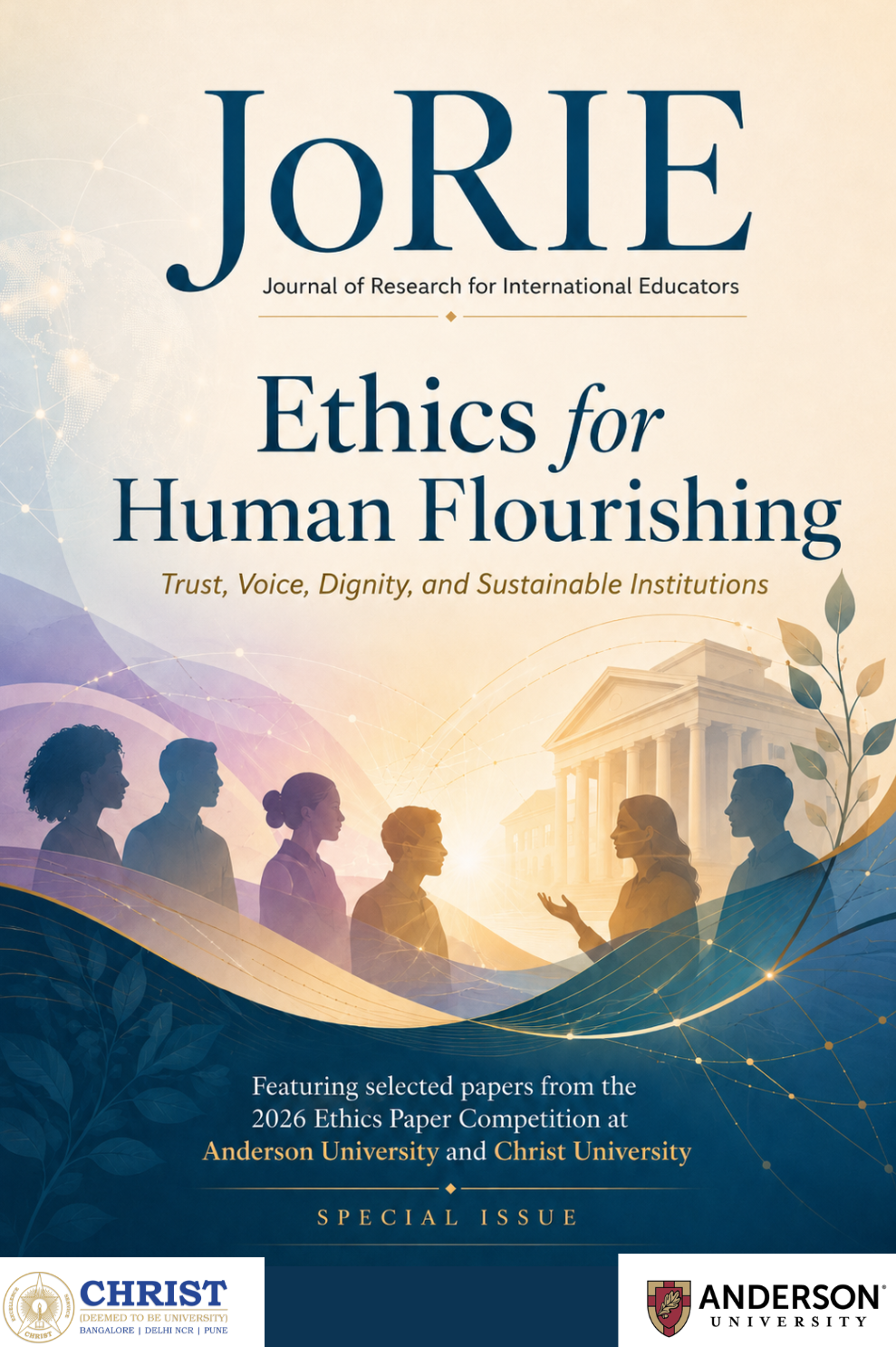
This special issue of JoRIE features papers developed through the 2026 Ethics Paper Competition at Anderson University and Christ University. Together, these student-authored papers explore how ethics is lived through the quality of relationships within organizations, markets, and institutions. Rather than treating ethics only as compliance, individual decision-making, or abstract principle, this issue examines the relational conditions that allow people and communities to flourish. Trust, dignity, voice, accountability, psychological safety, fairness, and shared responsibility are presented as essential foundations for ethical organizational life.
The papers in this issue consider how power, ambition, leadership, workplace expectations, sustainable finance, ESG outcomes, intergenerational learning, and institutional credibility shape the human experience of work and society. Some contributions examine how excessive power or self-serving ambition damages trust, silences candor, and reduces people to instruments of personal or organizational gain. Others explore how ethical leadership, reverse mentoring, transparent governance, sustainable investment, and value-aligned workplaces can rebuild the relational fabric necessary for flourishing.
Together, the issue advances a central claim: human flourishing depends on ethical relationships. Organizations and institutions flourish when people are treated with dignity, when voice is protected, when power is exercised as stewardship, and when ethical commitments are made visible through trustworthy practices and measurable outcomes. This issue invites readers to reconsider ethics not merely as avoiding wrongdoing, but as cultivating the relational, cultural, and institutional conditions through which people, organizations, communities, and ecosystems can thrive.
Conceptual Articles